


Smart Cities and Economic Efficiency: How Digital Infrastructure Could Transform Urban Economies

As urban economies face various challenges and opportunities in the digital age, digital infrastructure has become a crucial driver of transformation. This infrastructure, which includes high-speed internet, data networks, cloud computing, and smart city technologies, is reshaping how cities operate, grow, and compete in global markets. The economic impact of digital infrastructure is significant, contributing to the creation of more sustainable and equitable cities. It also promotes innovation and enhances productivity. This article utilizes economic theories such as Solow’s growth model, endogenous growth theory, and human capital theory to examine the effectiveness and demonstrate the economic potential of digital infrastructure in promoting transformation within urban environments.
The fundamental foundation for innovation, talent attraction, and economic growth in cities is provided by digital infrastructure. Unlike traditional physical infrastructure, which primarily supports industrial economies, digital infrastructure aligns more closely with the needs of knowledge-based and technology-driven economies. As a result, cities are gradually shifting their focus from physical to digital networks to drive economic development. Innovation initiatives in European cities like Barcelona, Stockholm, and Amsterdam reflect this change by investing in digital infrastructure to attract new businesses, develop a skilled workforce, and support entrepreneurship. These initiatives serve as important examples of economic recovery, promotion, and revitalization.
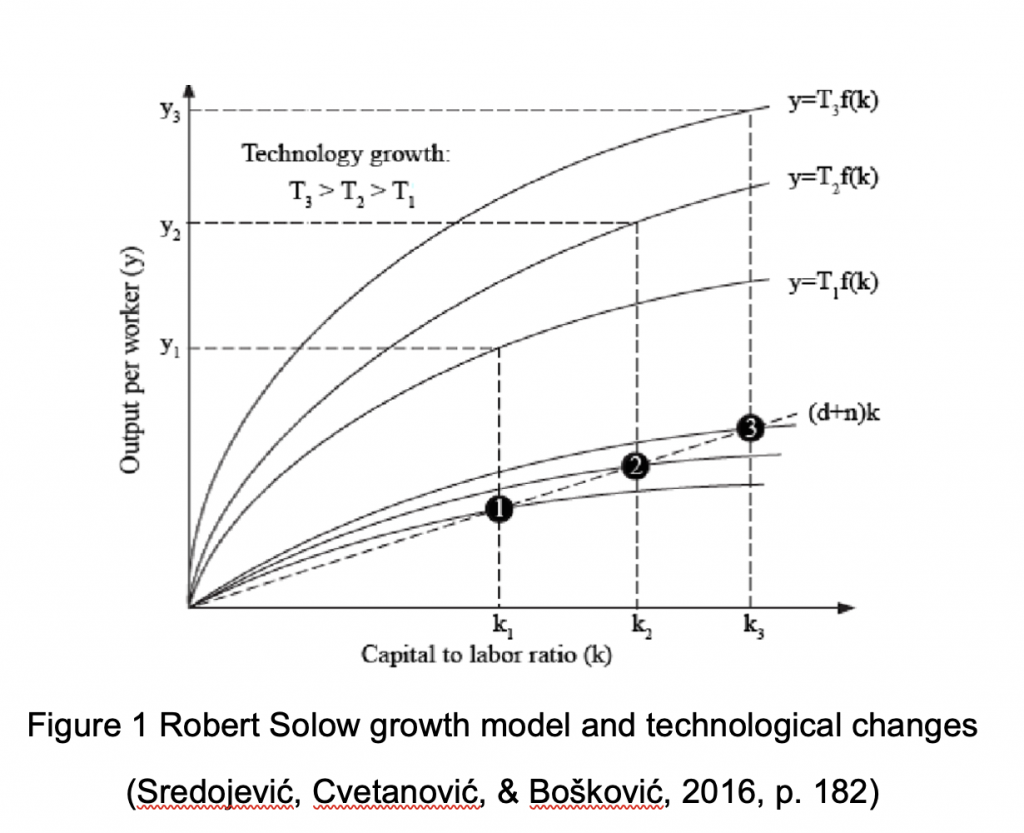
A key indicator of a city’s economic development is productivity growth, which is directly related to investments in digital infrastructure. By leveraging digital infrastructure, companies can improve communication efficiency, optimize supply chains, and streamline processes (Serrano, 2018). According to Solow’s economic growth model, technological advances, such as those in digital infrastructure, are essential for long-term economic growth (Figure 1). Digital infrastructure promotes more effective resource allocation through its influence on productivity and enables economies of scale, ultimately improving total factor productivity (TFP) (Tang & Zhao, 2023).
By increasing efficiencies across all domains, including public safety, healthcare, the urban environment, and transportation, digital infrastructure enhances the effectiveness of federal and local government administration. For example, intelligent traffic management systems can reduce traffic congestion, resulting in lower economic costs associated with lost productivity and pollution. Such efficient management leads to lower costs and more public funds for economic growth and innovation. This hypothesis is supported by endogenous growth theory, which argues that sustainable investment in urban technology and infrastructure can sustain long-term growth by creating a positive feedback loop between investment and economic production (Chang, Wu, & Zhang, 2022).
With support from both the public and private sectors, smart city investment is rapidly growing in Europe and is essential to accelerating digital transformation. The Horizon 2020 program, for example, is committed to providing significant funding for smart city initiatives that aim to enhance urban environments by utilizing cutting-edge technologies. As a result, in 2021, the EU announced funding for 73 projects worth over €1 billion through the Horizon 2020 European Green Deal Call and continues to fund similar projects through Horizon Europe (European Commission, 2021).
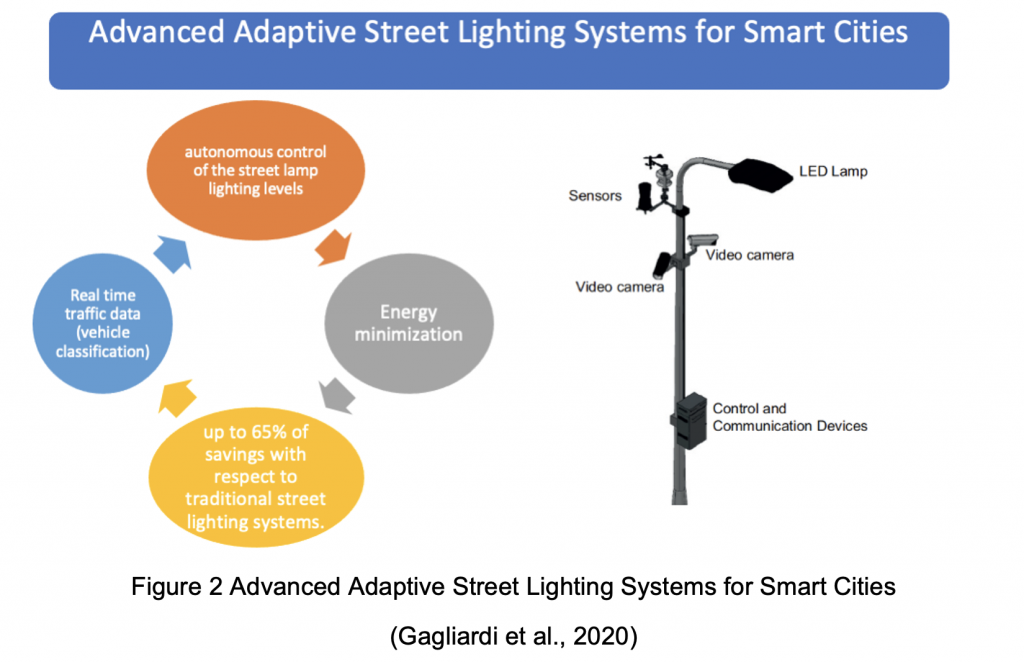
Barcelona is a prime example of how digital infrastructure can transform urban economies. The city has invested heavily in smart city projects that use digital technologies to reduce costs and improve public services. Barcelona has improved urban operations by introducing digital sensors, traffic management systems, and smart lighting systems (Figure 2). These efforts have led to energy savings of approximately 30%, significant annual cost savings exceeding €35 million, improved street safety, and more effective public lighting systems (Bibri & Krogstie, 2020). These savings have allowed government resources to be reinvested in job creation and other economic development programs, reflecting Solow’s model by showing how productivity improvements can translate into broader economic benefits.
Moreover, Barcelona’s commitment to digital infrastructure has created an entrepreneurial ecosystem, attracting tech startups and innovation hubs that contribute to job creation and economic revitalization. The city’s digitally connected environment exemplifies how cities can leverage technology to increase their economic competitiveness. This focus on entrepreneurship and innovation aligns with endogenous growth theory, emphasizing that technology and local knowledge contribute to a city’s long-term economic development.
A strong digital infrastructure enables the development of an innovative environment and is essential for promoting economic regeneration in urban areas. According to endogenous growth theory, technological advancements create continuous cycles of innovation that promote long-term economic growth. A 1% increase in the scale of the digital economy can lead to an approximate 0.3-0.4% increase in GDP per capita over time (Chang, Wu, & Zhang, 2022).
Digital infrastructure also enables rapid knowledge exchange, which is critical for accelerating innovation. It fosters collaborative platforms that support the growth of digital services such as remote work and e-commerce, expanding market access and creating new business opportunities. Easier access to communication and information fosters innovation and the growth of knowledge-intensive sectors, contributing to a thriving urban economy.
Stockholm demonstrates the ability of digital infrastructure to foster innovation. Through significant investment in internet and digital literacy projects, the city has attracted foreign investment and talent, establishing itself as a global leader in digital technology. According to Loreto (2017), the rise of technology companies such as Spotify and Skype illustrates how digital infrastructure can stimulate the development of the digital economy by creating an economic cycle that attracts further investment and talent. Stockholm’s digital infrastructure has increased incomes and productivity, giving the city a competitive edge and reinforcing the role of digital infrastructure as a long-term driver of economic growth.
One of the most promising aspects of digital infrastructure is its potential to enhance economic inclusivity by reducing barriers to access and enabling broader participation in the urban economy. According to inclusive growth theory, digital infrastructure is essential for inclusive development, providing access to resources for marginalized groups (Ali & Son, 2007). Thus, digital infrastructure holds great potential for reducing economic disparities and social inequalities by enabling disadvantaged populations to access financial, medical, and educational resources.
Human capital theory posits that economic development can be improved by investing in people through education and skills development (Becker, 1992). Digital infrastructure enhances access to online educational resources and vocational skill development, making urban residents more productive and employable. For underserved communities, digital access can be transformative, creating pathways out of poverty and fostering a more resilient urban economy.
Amsterdam’s digital infrastructure initiatives demonstrate a commitment to economic inclusivity. The city’s “Smart City” project includes programs aimed at providing digital access to all residents, regardless of income level. Amsterdam seeks to close the digital divide by offering digital literacy training and public Wi-Fi, enabling low-income residents to access online resources and job opportunities. For example, around 40% of homeless individuals who attend weekly meals at the Sant’Egidio Foundation in Amsterdam have access to smartphones, and this percentage is expected to rise. Given that most homeless people live in groups where at least one person often has a phone, mobile apps can be a valuable tool for disseminating information about services and resources (Bon et al., 2020). This strategy supports a more equitable urban economy and aligns with human capital theory, as access to digital resources fosters economic mobility and skills development.
By promoting inclusivity through advances in digital infrastructure, cities can create a more resilient and skilled workforce. Increasing digital literacy across all social and economic levels helps communities cultivate a workforce that is better trained, more resilient, and prepared for a technology-driven economy. Amsterdam’s focus on inclusivity serves as a paradigm in which digital infrastructure can promote both social justice and economic empowerment.
However, despite the potential for digital infrastructure to revolutionize urban economies, significant risks and challenges must be addressed. Issues such as data privacy, cybersecurity, and the digital divide hinder the full realization of digital transformation. For instance, the digital divide can exacerbate existing disparities if certain groups, such as low-income earners or rural residents, continue to have limited access to digital infrastructure (Cullen, 2001). Addressing these disparities and ensuring equitable benefits from digital infrastructure require targeted policy actions that balance innovation with digital concerns.
Data privacy and cybersecurity are critical as cities become increasingly reliant on digital infrastructure for service delivery. Investment in security technologies is essential for protecting personal information and preventing cyberattacks. Without adequate safeguards, public confidence in digital systems may decline, limiting potential economic benefits and complicating the adoption of digital services.
Digital infrastructure is, therefore, transforming Europe’s urban economies by enhancing innovation, productivity, and inclusivity, as exemplified by Stockholm, Amsterdam, and Barcelona. These changes contribute to resilient and sustainable growth, positioning urban economies to become key players in the global digital economy.
References
Ali, I., & Son, H. H. (2007). Measuring inclusive growth. Asian Development Review, 24(1), 11–31.
Becker, G. S. (1992). Human capital and the economy. Proceedings of the American Philosophical Society, 136(1), 85–92. https://www.jstor.org/stable/986801
Bibri, S. E., & Krogstie, J. (2020). The emerging data-driven Smart City and its innovative applied solutions for sustainability: The cases of London and Barcelona. Energy Informatics, 3(1), 5. https://doi.org/10.1186/s42162-020-00041-4
Bon, A., van den Nieuwenhuijzen, D., Akkermans, H., de Bour, W., Edoga, C., Hegeman, M., & Werdervoort, M. (2020). Digital divide, citizenship and inclusion in Amsterdam. Pangea.
Chang, Q., Wu, M., & Zhang, L. (2022). Endogenous growth and human capital accumulation in a data economy. Structural Change and Economic Dynamics, forthcoming. https://doi.org/10.2139/ssrn.4248918
Cullen, R. (2001). Addressing the digital divide. Online Information Review, 25(5), 311–320. https://doi.org/10.1108/14684520110410517
European Commission. (2021). Horizon Europe: Investing in smart cities. Retrieved from https://www.ec.europa.eu/horizon2020
Gagliardi, G., Lupia, M., Cario, G., Tedesco, F., Cicchello Gaccio, F., Lo Scudo, F., & Casavola, A. (2020). Advanced adaptive street lighting systems for smart cities. Smart Cities, 3(4), 1495–1512. https://doi.org/10.3390/smartcities3040071
Loreto, J. (2017). The impulse of regional growth in the creative economy: An analysis of the creative city of Stockholm. The case study of Spotify.
Serrano, W. (2018). Digital systems in smart city and infrastructure: Digital as a service. Smart Cities, 1(1), 134–154. https://doi.org/10.3390/smartcities1010008
Sredojević, D., Cvetanović, S., & Bošković, G. (2016). Technological changes in economic growth theory: Neoclassical, endogenous, and evolutionary-institutional approach. Economic Themes, 54(2), 177–194. https://doi.org/10.1515/ethemes-2016-0009
Tang, J., & Zhao, X. (2023). Does the new digital infrastructure improve total factor productivity? Bulletin of Economic Research, 75(4), 895–916. https://doi.org/10.1111/boer.12388